
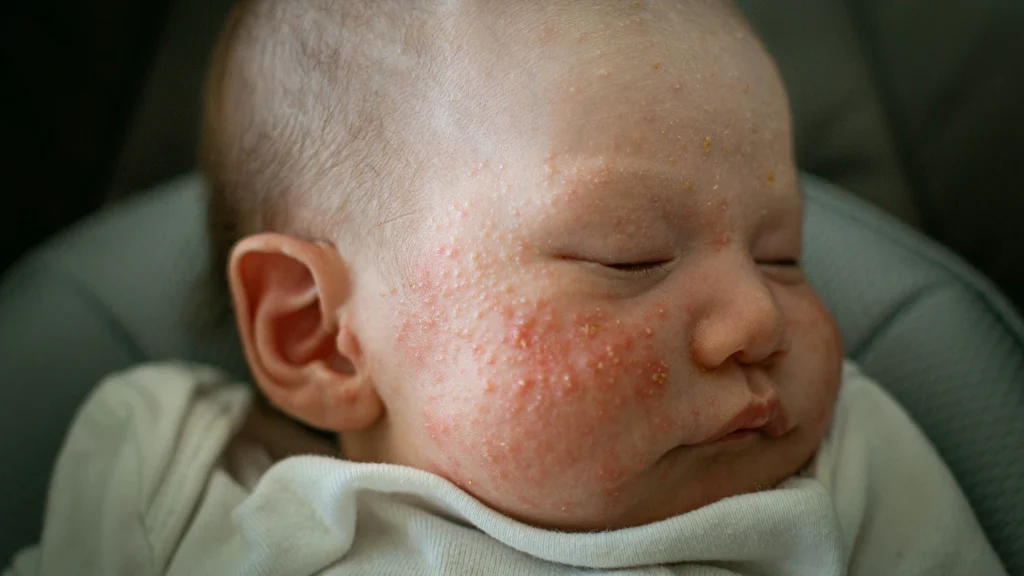
Baby eczema – dry, red and often intensely itchy patches of skin – commonly appears on the cheeks, scalp and joints during infancy. It is one of the conditions researchers have studied in relation to the gut-skin axis, the communication between the gut, immune system and skin.
The connection is particularly interesting during infancy because the first years of life are an important period for both immune development and the establishment of the gut microbiome.
But there is an important distinction: having a different gut microbiome does not mean that gut bacteria cause eczema. Genetics, the skin barrier, immune responses and environmental factors all contribute to eczema risk.
Why Early Gut Development Matters for Eczema
The first years of life are a major period of microbiome development. Researchers are investigating whether changes in the infant gut microbiome influence immune development and the risk of allergic conditions such as eczema.
Mode of delivery
Babies born by caesarean section tend to develop a different early gut microbiome from babies born vaginally. Some observational studies have also reported an association between caesarean birth and a modestly higher risk of eczema.
However, this does not mean that caesarean delivery causes eczema.
The microbiome is influenced by many factors, including feeding, antibiotics, genetics and the surrounding environment. Caesarean delivery is also often medically necessary, and parents should never interpret this information as something they did wrong.
Breastfeeding and gut development
Breast milk contains carbohydrates called human milk oligosaccharides that help support particular bacteria in an infant’s developing gut.
This has led researchers to investigate whether breastfeeding might influence the development of allergic conditions.
However, the evidence specifically linking breastfeeding with eczema prevention is mixed. A systematic review and meta-analysis of prospective studies found no overall association between breastfeeding and atopic dermatitis, although some subgroups appeared to show possible protective effects.
So breastfeeding has many established benefits, but it should not be presented as a guaranteed way to prevent eczema.
For more information about the importance of early-life development, see GHASA’s article on The First 1,000 Days: Seeding the Foundation of a Child’s Brain.
Early antibiotic exposure
Antibiotics can alter the gut microbiome, which is one reason researchers have investigated whether antibiotic exposure during early life might influence allergic conditions.
Some observational research has found associations between early antibiotic exposure and eczema. However, these studies cannot always separate the effect of antibiotics from the reason the antibiotic was prescribed or other factors affecting the child’s health.
The practical takeaway is simple: antibiotics should be used when medically appropriate, but they should not be avoided when a doctor determines that a child genuinely needs them.
Early food introduction
The way parents introduce foods during infancy has also changed considerably over the past decade.
Older advice sometimes encouraged parents to delay potentially allergenic foods. Current allergy-prevention guidance generally supports introducing developmentally appropriate common allergens when infants are ready for complementary foods, rather than deliberately delaying them.
This is particularly relevant because eczema and food allergy can occur together.
Parents should follow advice from their paediatrician, especially when a baby already has significant eczema or a known food allergy.
This Doesn’t Mean Any Individual Case Is Anyone’s “Fault”
This point deserves emphasis.
Many babies develop eczema despite breastfeeding, vaginal delivery and no early antibiotic exposure. Others have several factors that researchers associate with eczema risk and never develop the condition.
Genetics plays an important role, and eczema is multifactorial.
The purpose of understanding the gut-skin connection is therefore not to assign blame to parents.
A medically necessary caesarean section, formula feeding, antibiotic treatment or another early-life circumstance does not mean a parent caused their baby’s eczema.
Instead, research into the microbiome may eventually help researchers understand why some babies develop eczema and whether certain interventions can reduce its severity or risk.
Managing Eczema Alongside Gut Health Support
Follow the treatment plan for the skin
If your baby has eczema, treatment of the eczema itself should come first.
Regular moisturising and appropriate topical treatments recommended by a paediatrician or dermatologist remain central to eczema management.
Gut-health strategies should be considered complementary, not replacements for established eczema treatment.
Offer a varied, age-appropriate diet
Once your baby is developmentally ready for complementary foods, aim for a varied diet appropriate for their age and follow current guidance around allergen introduction.
Avoid unnecessary restrictive diets unless a healthcare professional has identified a specific reason for one.
Be cautious with probiotics
This is an area where the science is particularly interesting – but also where marketing can get ahead of the evidence.
Some earlier studies and meta-analyses suggested that certain probiotic preparations might reduce the risk or severity of eczema. However, results have not been consistent.
A recent 2026 systematic review and meta-analysis looked specifically at probiotic supplementation started during infancy. It included 18 randomised controlled trials involving more than 10,000 participants and found no significant protective effect from infant-only probiotic supplementation.
This is an important update to the evidence.
It means parents should not assume that giving a baby a generic probiotic will prevent eczema. Different bacterial strains, doses, timing and combinations may produce different results, and researchers are still working out which approaches, if any, are clinically useful.
Don’t automatically remove foods from a breastfeeding mother’s diet
When a breastfed baby develops eczema, parents sometimes immediately remove dairy, eggs or other foods from the mother’s diet.
This should not be done routinely without professional guidance.
Unnecessary dietary restriction can make it harder for the mother to meet her own nutritional needs, while the underlying cause of the baby’s eczema may have nothing to do with the mother’s diet.
If you suspect that a particular food is triggering symptoms, discuss it with your paediatrician or a registered dietitian.
You can also read GHASA’s article on Understanding Strong Reactions to Fermented Foods for more information about food-related reactions and the gut.
Frequently Asked Questions
Will my baby’s eczema definitely mean they will develop other allergies?
No.
Children with eczema have a higher likelihood of developing other allergic conditions, including food allergies, asthma and allergic rhinitis. This pattern is sometimes described as the “atopic march.”
However, it does not happen to every child.
Many children experience significant improvement in their eczema as they grow, and having eczema does not mean that a child will inevitably develop other allergic conditions.
Can I prevent eczema through gut-health measures during pregnancy?
There is currently no guaranteed way to prevent eczema.
A varied, nutritious diet during pregnancy supports maternal and infant health, but extreme dietary restriction specifically to prevent eczema is not supported by strong evidence.
Research into maternal diet, probiotics and the developing infant microbiome continues, but parents should be cautious about products making strong prevention claims.
Is it worth trying probiotic drops for my baby’s eczema?
Talk to your paediatrician first.
Research into probiotics and eczema has produced mixed results. Some earlier meta-analyses found potential benefits, while more recent evidence has been less convincing, particularly for probiotics given only to infants.
For example, a 2019 systematic review found potential benefits from probiotic supplementation in some circumstances, particularly when supplementation occurred during both the prenatal and postnatal periods.
However, a newer 2026 analysis found no significant preventive effect from infant-only probiotic supplementation.
This illustrates why the specific strain, timing and population studied matter. A generic probiotic product should not automatically be assumed to provide the same benefits as a product used in a clinical trial.
Can improving my baby’s gut microbiome cure eczema?
No.
There is currently no established microbiome treatment that can cure eczema.
Researchers are investigating the relationship between gut bacteria, immune development and eczema, but the gut microbiome is only one part of a much larger picture involving genetics, the skin barrier, immune responses and environmental factors.
GHASA’s Role
GHASA is committed to helping South African parents understand the developing science around gut health, the microbiome and childhood conditions such as eczema.
The gut-skin connection is a promising area of research, but promising research should not be confused with established treatment.
Parents deserve information that explains what researchers know, what remains uncertain and what should be discussed with a healthcare professional.
Most importantly, a baby’s eczema is not a parent’s failure. Supporting gut health can be part of overall healthy development, but it should sit alongside – not replace – appropriate medical care for eczema.
This article is intended for educational purposes only and should not replace advice from a qualified paediatrician, dermatologist or other healthcare professional.
Scientific sources
- Wei T, Ding Y. Efficacy of probiotics in preventing atopic dermatitis in infants: A systematic review and meta-analysis. Journal of International Medical Research. 2026. This recent review included 18 randomised controlled trials involving 10,195 participants and found no significant protective effect from infant-only probiotic supplementation.
Read the 2026 systematic review on PubMed - Petersen EB, et al. Role of the Gut Microbiota in Atopic Dermatitis: A Systematic Review. Acta Dermato-Venereologica. 2019;99(1):5–11. The review examined 44 studies and concluded that evidence concerning the role of the gut microbiome in the onset and severity of atopic dermatitis remained conflicting.
Read the peer-reviewed review on PubMed