
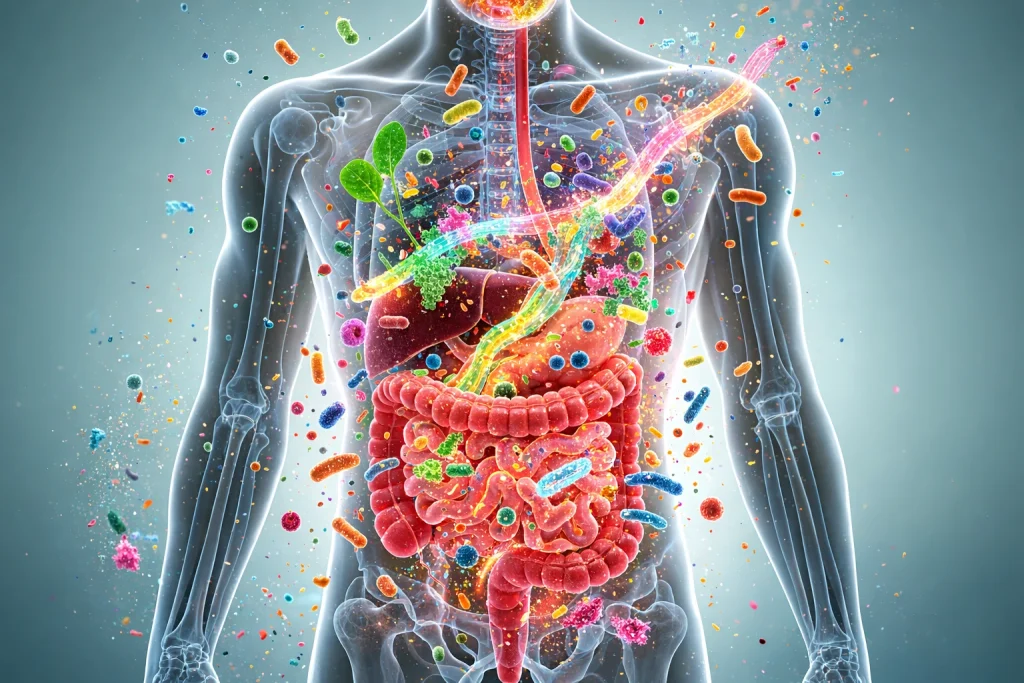
A deep dive into the fascinating science of personalised nutrition and your gut microbiome
You’ve probably heard the saying “you are what you eat.” But science is revealing something even more surprising: the way you respond to food is deeply personal – and a lot of that comes down to the trillions of microbes living inside your gut.
A landmark review published in Nature Reviews Microbiology by Kolodziejczyk, Zheng, and Elinav (2019) brings together decades of research to paint a vivid picture of how our diet shapes the community of bacteria in our gut – and how those bacteria, in turn, shape our health. The implications are profound: the same meal can have completely different effects on two different people, and understanding why could revolutionize the way we think about food, disease, and medicine.
What Is the Gut Microbiome, Anyway?
Your gut is home to hundreds of billions of microorganisms – mostly bacteria – collectively called the gut microbiome. Think of it as a vast, living ecosystem packed into your digestive tract. These microbes help you digest food, produce vitamins, train your immune system, and even communicate with your brain.
The composition of this community is surprisingly unique to each person. Like a fingerprint, your microbiome is shaped by where you grew up, how you were born, what you ate as a child, the medications you’ve taken, and crucially – what you eat day to day.
Food Is the Most Powerful Force Shaping Your Gut Bacteria
Of all the factors that influence which bacteria thrive in your gut, diet is the most powerful. Studies of populations around the world make this strikingly clear.
Seasons Change Your Microbiome
Researchers studying the Hadza hunter-gatherers of Tanzania found that their gut microbiomes change dramatically with the seasons. In the wet season, when the Hadza forage for berries and honey, their gut bacteria look completely different from the dry season, when hunting dominates. Gut microbes that specialize in digesting plant carbohydrates become far more or less abundant depending on what’s available to eat. This is a remarkable demonstration of just how responsive our microbiomes are – they’re shifting constantly to match our diet.
Westernization Is Transforming Our Inner Ecosystems
Perhaps the most striking evidence comes from comparing populations that eat traditional diets with those eating modern Western diets. People in rural, non-westernized societies tend to have far greater microbial diversity than those in industrialized countries. Rural diets – rich in fibre, raw foods, and complex carbohydrates – support a wider variety of gut bacteria.
When people migrate from developing countries to the West, their gut microbiomes begin to shift toward a Western profile within just six to nine months. Bacteria typical of non-Western guts start getting replaced by species associated with the Western diet. Research from Vangay et al. (2018) published in Cell documented this dramatic transformation in Southeast Asian immigrants, finding not just microbial change but also a loss of diversity that didn’t recover even after years of living in the US.
The concern? Lower microbial diversity is consistently linked to worse metabolic health, inflammation, and disease risk.
What You Eat Changes Your Gut Bacteria Fast
One of the most eye-opening findings in this field is just how quickly diet can change your microbiome. A landmark study by David et al. (2014) in Nature showed that switching to either a fully animal-based or fully plant-based diet altered the gut microbiome within just four days. In mice, switching from a low-fat, plant-rich diet to a high-fat, high-sugar diet rewired the microbial community within a single day.
This is both exciting and sobering. It means you have real power to influence your gut microbiome through what you eat. But it also means that sliding back into unhealthy eating habits can quickly undo the benefits.
Fat, Protein, and Carbohydrates Each Leave Their Mark
Different macronutrients affect gut bacteria in distinct ways:
Dietary fat has a profound effect. High saturated fat intake is linked to reduced microbial diversity and changes in bacteria associated with cardiovascular risk. On the other hand, omega-3 polyunsaturated fatty acids (found in oily fish, flaxseeds, and walnuts) appear to increase beneficial butyrate-producing bacteria.
Protein source matters too. A diet rich in animal protein shifts the balance toward bile-tolerant bacteria and reduces beneficial fibre-fermenting species. In contrast, plant protein – such as from peas – increases levels of friendly lactobacilli and bifidobacteria, and boosts production of short-chain fatty acids (SCFAs), small molecules that are enormously good for gut health.
Dietary fibre is arguably the most important factor. Fibre feeds your gut bacteria, and bacteria that eat fibre produce SCFAs – including butyrate, propionate, and acetate. These compounds are a critical energy source for the cells lining your gut and have powerful anti-inflammatory effects. Diets low in fibre lead to a reduction in these beneficial bacteria and a drop in protective SCFAs. In mouse studies, fibre deprivation caused gut-barrier-degrading bacteria to expand, making the intestine more vulnerable to infection and inflammation.
Your Microbiome Is Unique – And So Is Your Response to Food
Here’s where things get really interesting. Even when two people eat exactly the same meal, their blood sugar, inflammation, and fat metabolism can respond completely differently. And a major reason for this? The unique community of bacteria living in each person’s gut.
A landmark study by Zeevi et al. (2015), published in Cell, put this to the test with 800 people in Israel. The researchers tracked participants’ blood sugar responses to hundreds of different foods and found enormous variation between individuals. Remarkably, they were able to predict how a person’s blood sugar would respond to a specific meal using a combination of their gut microbiome profile, blood tests, dietary habits, and body measurements – all processed by a machine-learning algorithm. When they used these predictions to design personalised diets, participants’ blood sugar control improved significantly.
This study was a turning point. It suggested that the “one-size-fits-all” approach to dietary advice – eat less sugar, eat more fibre – may be missing something important. What works for one person may not work for another, and the microbiome is a key part of why.
This finding was later confirmed in the United States by Mendes-Soares et al. (2019), and a large twin study (Berry et al., 2019) involving over 1,000 participants showed that even identical twins respond differently to the same meals – pointing squarely to non-genetic factors like the gut microbiome.
The Bacteria in Your Gut Are Chemical Factories
Beyond digesting food, your gut microbiome produces a remarkable array of chemical compounds that circulate throughout your body and influence virtually every organ.
Short-Chain Fatty Acids: Your Gut’s Best Friends
When bacteria ferment dietary fibre, they produce SCFAs – particularly butyrate, propionate, and acetate. These molecules:
- Nourish the cells lining the gut, keeping the intestinal wall strong and healthy
- Act as signalling molecules that regulate immune responses and reduce inflammation
- Help control appetite by triggering the release of gut hormones
- Act as “epigenetic” switches in immune cells and fat cells, influencing how genes are expressed
Faecalibacterium prausnitzii, one of the most-studied SCFA producers, is often found in lower levels in people with inflammatory bowel disease – suggesting its absence may contribute to gut inflammation.
TMAO: A Warning From Red Meat
Not all microbial chemistry is good news. When bacteria break down L-carnitine, choline, and phosphatidylcholine – compounds found in red meat, eggs, and dairy – they produce a molecule called trimethylamine N-oxide (TMAO). Research by Koeth et al. (2013) in Nature Medicine linked high blood levels of TMAO to significantly increased risk of cardiovascular disease. Interestingly, vegetarians and vegans tend to have lower levels of TMAO-producing bacteria, which may partly explain why plant-based diets are associated with heart health benefits.
Tryptophan Metabolites and the Gut-Brain Connection
Bacteria can also transform the amino acid tryptophan (found in turkey, eggs, and seeds) into a range of bioactive compounds called indoles. These molecules play roles in modulating the immune system, regulating gut hormone secretion, and maintaining barrier integrity. Disruptions in tryptophan metabolism by gut bacteria have been linked to inflammatory conditions and potentially even neurological disorders – a fascinating area of active research.
Your Microbiome Can Predict Whether a Diet Will Work for You
The research is revealing that baseline gut microbiome composition can predict whether a dietary intervention will be effective for a particular person.
For example, people who had higher levels of the bacterium Prevotella in their gut showed better blood sugar responses to eating barley bread – a fibre-rich food. People with higher levels of Akkermansia muciniphila lost more body fat and showed better improvements in insulin sensitivity on a calorie-restricted diet. Children with irritable bowel syndrome who responded well to a low-FODMAP diet had distinctly different gut bacteria from those who did not respond.
These findings point toward a future where a simple analysis of your gut microbiome could tell a doctor – or even an app on your phone – which dietary strategies are most likely to work for you.
Meal Timing Matters Too
It’s not just what you eat – when you eat also shapes your microbiome. Gut bacteria follow a daily rhythm that mirrors the body’s own circadian clock. Disrupting this rhythm – through shift work, jet lag, or late-night eating – appears to disturb the microbiome and has been linked to metabolic problems.
Intermittent fasting, where eating is restricted to certain hours of the day, has shown promising effects on gut microbiome composition in both animal studies and early human research. In mice, intermittent fasting shifted the microbiome in ways that promoted fat burning and reversed diet-induced obesity. It also protected against multiple sclerosis-like disease in mouse models, an effect that was mediated by changes in the gut microbiome.
The Challenge: Your Microbiome Has a Long Memory
Here’s a cautionary note: reshaping the gut microbiome is harder than it might seem. In some people, obesity-related microbiome changes persist even after successful weight loss. This lingering microbial legacy can drive faster weight regain – a biological headwind that helps explain why sustaining weight loss is so difficult.
Research in mice also showed that eating a low-fibre diet over multiple generations causes a progressive loss of microbial diversity that cannot be fully reversed simply by reintroducing fibre. This suggests that decades of low-fibre Western diets may have consequences for our microbiomes that are difficult to undo.
What Does This Mean for You?
The science of diet-microbiome interactions is still young, and we don’t yet have the tools to give everyone a perfectly personalised diet prescription based on their microbiome. But the research points toward several general principles that hold up across populations:
Eat more fibre. Dietary fibre is the primary food source for beneficial gut bacteria. Vegetables, legumes, whole grains, and fruits all contribute to a diverse, thriving microbiome.
Diversify your plant foods. Different types of fibre feed different bacteria. Eating a wide variety of plant foods helps maintain a diverse microbiome.
Limit ultra-processed foods. Emulsifiers and artificial sweeteners – common in processed foods – have been shown to alter gut bacteria in concerning ways, including by disrupting the mucus layer that protects the gut wall.
Be thoughtful about red meat. High animal protein and saturated fat intakes are consistently associated with less favourable microbial profiles.
Consider meal timing. Eating in alignment with your body’s natural daily rhythms – avoiding late-night eating – may support healthier gut bacteria.
The Future: Personalised Nutrition for Everyone
The vision scientists are working toward is genuinely exciting: a future where a stool sample analysis, combined with blood tests and lifestyle data, generates a personalised dietary plan optimized for your unique microbiome. This could help control blood sugar in diabetes, reduce inflammation in autoimmune conditions, lower cardiovascular risk, and even improve mental health through the gut-brain axis.
Getting there will require large clinical trials, better computational tools, and a much deeper understanding of the complex, three-way conversation between food, microbes, and human physiology. But as Kolodziejczyk, Zheng, and Elinav write in their review, the latest advances “bode well for the future” – and the prospect of harnessing nutrition to prevent and treat disease in a truly personal way is no longer science fiction.
Key Papers Referenced
- Kolodziejczyk AA, Zheng D, Elinav E (2019). “Diet–microbiota interactions and personalised nutrition.” Nature Reviews Microbiology. https://doi.org/10.1038/s41579-019-0256-8
- Zeevi D et al. (2015). “personalised nutrition by prediction of glycemic responses.” Cell, 163, 1079–1094. (The landmark Israeli study showing microbiome-based blood sugar prediction)
- David LA et al. (2014). “Diet rapidly and reproducibly alters the human gut microbiome.” Nature, 505, 559–563.
- Vangay P et al. (2018). “US immigration westernizes the human gut microbiome.” Cell, 175, 962–972.
- Koeth RA et al. (2013). “Intestinal microbiota metabolism of L-carnitine, a nutrient in red meat, promotes atherosclerosis.” Nature Medicine, 19, 576–585.
- Sonnenburg ED et al. (2016). “Diet-induced extinctions in the gut microbiota compound over generations.” Nature, 529, 212–215.
- Smits SA et al. (2017). “Seasonal cycling in the gut microbiome of the Hadza hunter-gatherers of Tanzania.” Science, 357, 802–806.
- Berry S et al. (2019). “Large inter-individual variation in postprandial lipemia following a mixed meal in over 1,000 twins and singletons.” PREDICT I Study.
Written for a general science audience. All claims are based on peer-reviewed research. The science of the microbiome is fast-moving – consult a healthcare professional before making significant dietary changes.
Author: Diego Castillo, PhD in Genetics specialised in Microbiomics